Condoms and Condom Sizes: Answers to ALL Your Questions
There are so many questions about condoms, condom sizes, and penises—from how they’re made, to questions about choosing the right size and using them correctly, all the way to buying them.
In this blog post, we’d like to answer ALL your questions on the topic or point you in the direction of a detailed answer to your question.
So, what are you waiting for? Go ahead and read the post right now!
How is a condom made?
Making condoms is actually quite simple, but not easy. Before we get into the manufacturing process, let’s first take a look at the milky sap (natural rubber latex) that’s used in the process.
What are latex condoms made of?
Natural rubber latex, or natural rubber, is a milky sap extracted from the bark of rubber trees. The bark is tapped, and the sap that flows out is collected. (See Wikipedia)
The sap is mainly produced in Asia, as the climatic conditions there are ideal.
The natural rubber is then delivered to factories, where it is further processed.
What material are latex-free condoms for people with allergies made of?
In addition to latex condoms, there are also numerous types of condoms that are latex-free and perfect for people with allergies. They’re also ideal for people who don’t like latex.
Among other materials, condoms are made from:
Or other, more experimental condom materials such as:
How is natural rubber processed for condoms?
The latex is first further processed, stirred, and cured at the factory before glass rods are dipped repeatedly into the latex.
This is how the condom is built up layer by layer before being heated to over 100°C for a few minutes. This process gives the latex condoms their elasticity.
This is followed by additional steps such as powdering, electronic safety testing, rolling, moistening with lubricant, and packaging.
After all these steps, a sterile medical device known as a condom is produced.

How effective are condoms as a form of birth control?
Condoms are among the safest, most effective, and hormone-free methods of birth control currently available. (EK Suggested wording: ...is one of the safest, most effective, hormone-free contraceptives (reason for this suggestion: This makes it one of the safest among hormone-free contraceptives))
First, because it reliably prevents pregnancy when used correctly; second, because it also protects against most sexually transmitted infections.
This is an advantage that few other contraceptive methods offer.
According to the Pearl Index, the effectiveness rate of condoms is between 88 and 98 percent.
This means that, statistically speaking, out of 100 women who use this method regularly for one year, between 2 and 12 will become pregnant.
It is extremely important to note that most pregnancies result from incorrect use rather than from defective products.
What shapes, colors, and special features do condoms come in?
Condoms come in a wide variety of shapes and colors, as well as with other special features.
While the color and flavors (literally) of condoms are a matter of personal preference, the shapes and other special features play an important role in choosing the best condom.
After all, every penis and every person is unique and has different needs.
For example, if you have a penis with a large glans, a condom with more room at the tip is better suited for you than one in the classic cylindrical shape.
Or if you ejaculate very quickly or want to enjoy anal sex, you might want to try condoms that have a numbing effect or are specifically designed for anal sex.
You can find more information about shapes, colors, flavors, wall thicknesses, etc., here.
What condom sizes are available?
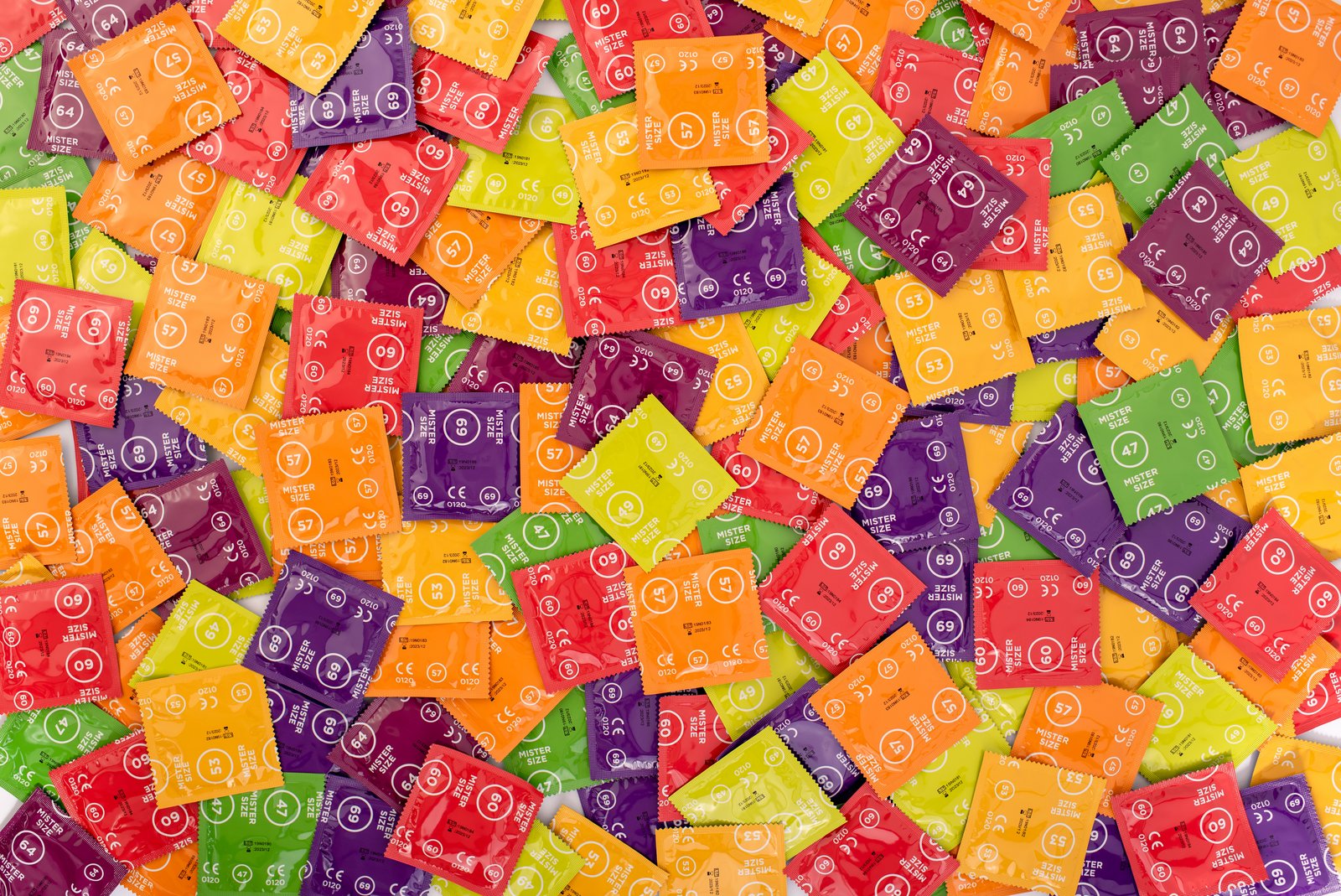
Here’s a clear table showing the most common condom sizes for you.
In the table, you can also see the approximate penis girth, diameter, and length for which the different condom sizes are suitable.
Penis length does not play a role in choosing the right condom. Even if the condom only partially covers the penis, it still protects against unintended pregnancies as long as the correct condom size has been chosen.
Condom Size | For Penis Circumference | For Penis Diameter |
Size 47 | 9.5 – 10 cm | 3.02 – 3.18 cm |
Size 49 | 10 – 10.5 cm | 3.18 – 3.34 cm |
Size 53 | 10.5 – 12 cm | 3.34 – 3.82 cm |
Size 57 | 12 – 13.5 cm | 3.82 – 4.3 cm |
Size 60 | 13.5 – 14.5 cm | 4.3 – 4.62 cm |
Size 64 | 14.5 – 15.5 cm | 4.62 – 4.93 cm |
Size 69 | More than 15.5 cm | More than 4.93 cm |
What is my condom size?
The only way to find out which condom size is right for you or your partner is to measure or try them on.
There are several ways to determine your condom size before buying:
- Measuring tape
- Ruler or folding ruler
- Smartphone app
- Measuring devices like the Condom Sizer
Here you’ll find an overview and instructions on the different methods you can use to find the perfect condom size.
What is the average condom size in Germany?
Statistically speaking, the average condom size in Germany is likely around 57. (See “Average Penis Size” further down in this article.)
However, according to some sources, around 80% of men in Germany use condom sizes 52 or 53.
Who are condoms for? Singles? Couples in relationships? Kids?
Condoms are mainly used by singles, but in recent years they have also become increasingly popular among people in relationships as an alternative to hormonal birth control.
Condoms are absolutely essential, especially when you have multiple sexual partners, so that everyone involved can reliably protect themselves against sexually transmitted infections (STIs or STDs).
Even if you and your partner don’t have any symptoms, that doesn’t rule out the possibility that you might still have a sexually transmitted disease.
In particular, diseases like chlamydia or syphilis can often remain asymptomatic or present with only mild symptoms.
There are currently no condoms specifically designed for kids or teenagers, which is why it’s all the more important that smaller condom sizes, such as 45 or 47, are available for purchase.
Are there condoms for women?
Yes, there are condoms for women. These condoms are called Femidoms and have been available since the 1990s.
Similar to condoms for men, the Femidom is a hormone-free method of contraception that protects against unintended pregnancies and sexually transmitted diseases such as HIV.
Which condom is best for me?
To find the best condom for you, you first need to measure the circumference of your penis and take a closer look at its shape. This information will then help you choose the condom that fits you best.
What are the different penis shapes?
Every penis is unique—whether circumcised or uncircumcised, straight or curved. The good news is that condoms are flexible enough to fit the penis perfectly, no matter what shape it is.
The only important factor for finding the perfect condom is the girth or diameter of the penis. If your glans is larger than the shaft of your penis, that could be another important consideration for you.
You can find an overview of 6 different penis shapes and what they say about the wearer’s personality here.
What is the average penis size in Germany, Europe, and the world?
If you’ve ever wondered what the average penis size is in Germany, Europe, or around the world, here’s a comparison for you:
- In Germany, the average penis size is 14.61 cm in length with a circumference of 11.8 cm
- In Europe, the average penis size is 14.27 cm in length and 11.70 cm in girth
- In France, the average is 15.48 cm in length and 13.63 cm in girth. This means that French men have the longest and thickest penises in Europe
- In Greece, men have an average length of 12.18 cm and a circumference of 10.19 cm
- You can find a table with information and a comparison of penis lengths worldwide here: https://www.laenderdaten.info/durchschnittliche-penisgroessen.php
How do I use a condom?
Using a condom correctly isn’t rocket science, but there are a few things you should definitely keep in mind before you use it:
- The condom’s plastic wrapper should be undamaged
- The condom should not be past its expiration date
- You should use the right condom size
- It should be latex-free if you’re allergic to latex
- Your hands should be clean
If all these conditions are met, you can start putting it on.
How do I put on a condom correctly?
You can read detailed instructions on how to put on a condom, as well as the most common mistakes and problems, in this article.
It’s important to use the right condom size so that it fits snugly but not too tightly, and you should unroll it as far as possible toward the base of the penis.
Can I use condoms and lube together?
If you want to use lubricant with condoms, you must make sure not to use oil-based lubricants and that you don’t have anything else containing grease or oil on your fingers.
This is because fats and oils break down condoms, making them porous and thus brittle and unsafe.
You generally can’t go wrong with water-based or silicone-based lubricants.
Click here for a comparison of lubricants and a guide on how to find the best one for you.
How long do condoms last, and can they expire?
Condoms usually have a shelf life of up to 5 years; after that, they start to become porous and lose their effectiveness.
Some companies play it safe with the expiration date and list a shorter shelf life.
You should not use expired condoms because they no longer provide protection.
It’s also important to note that certain factors can shorten a condom’s shelf life.
When should you stop using condoms?
You should stop using condoms if:
- You put it on your penis the wrong way around
- You had semen or pre-ejaculate on your fingers while unwrapping it
- The condom package is damaged
- The condom’s expiration date has passed
- The condom has been exposed to excessive light or heat
- The condom is too small
- The condom is too big
- You’ve already used the condom (always use it only once)
- You’ve had it in your wallet or purse for ages
- Oil-based lubricant, massage oil, or other fats and oils have come into contact with the condom
Where can I buy condoms?
You can buy condoms locally at most pharmacies, drugstores, supermarkets, and discount stores, as well as at many online shops.
You can buy condoms on Sundays at gas stations or from condom vending machines.
Just check out our Shop section—there you’ll find the top retailers for every condom size.
At what age can you buy condoms?
There’s no age restriction for condoms, which means that, in principle, any child, teenager, or adult can buy condoms online or in stores.
Which condoms should I buy as a woman?
Which condoms you should buy as a woman depends on whether you want to buy condoms for your vagina (Femidom), for your current partner’s penis, or for a potential partner’s penis.
If you want to buy a condom for your current or potential partner, you should first find out the condom size.
If you or the person using the condom don’t know the size, you should measure the penis briefly.
If you frequently change partners, it’s best to keep the most common sizes at home or buy a few sample packs that include multiple condom sizes.
The History of Condoms
Did you know that the first “clothed” penises can already be seen in cave paintings from about 14,000 years ago?
Or that the first condom was made from a goat’s bladder in Greece?
You’ll find many other fascinating facts about the history and development of condoms from antiquity to the present day in this article.
Find out here why the condom is called a “condom.”
Conclusion
We hope we’ve been able to answer all your questions about condoms, condom sizes, and contraception using condoms.
If you still have questions, feel free to email us anytime or message us on our social media profiles.
Otherwise, don’t waste any more time—download our free measuring tape to determine the right condom size.